
Not Lady-Like

If you’re a woman in Hollywood, these stories will feel familiar. But as I tell my students, I’ve seen 16 Candles, not your high school coming-of-age story. I think it’s worth making others feel less alone by telling my version of being a cis white female in this business.
Spoiler: It’s not always bad. I love my varied gendered superpowers. And, it’s not always good.
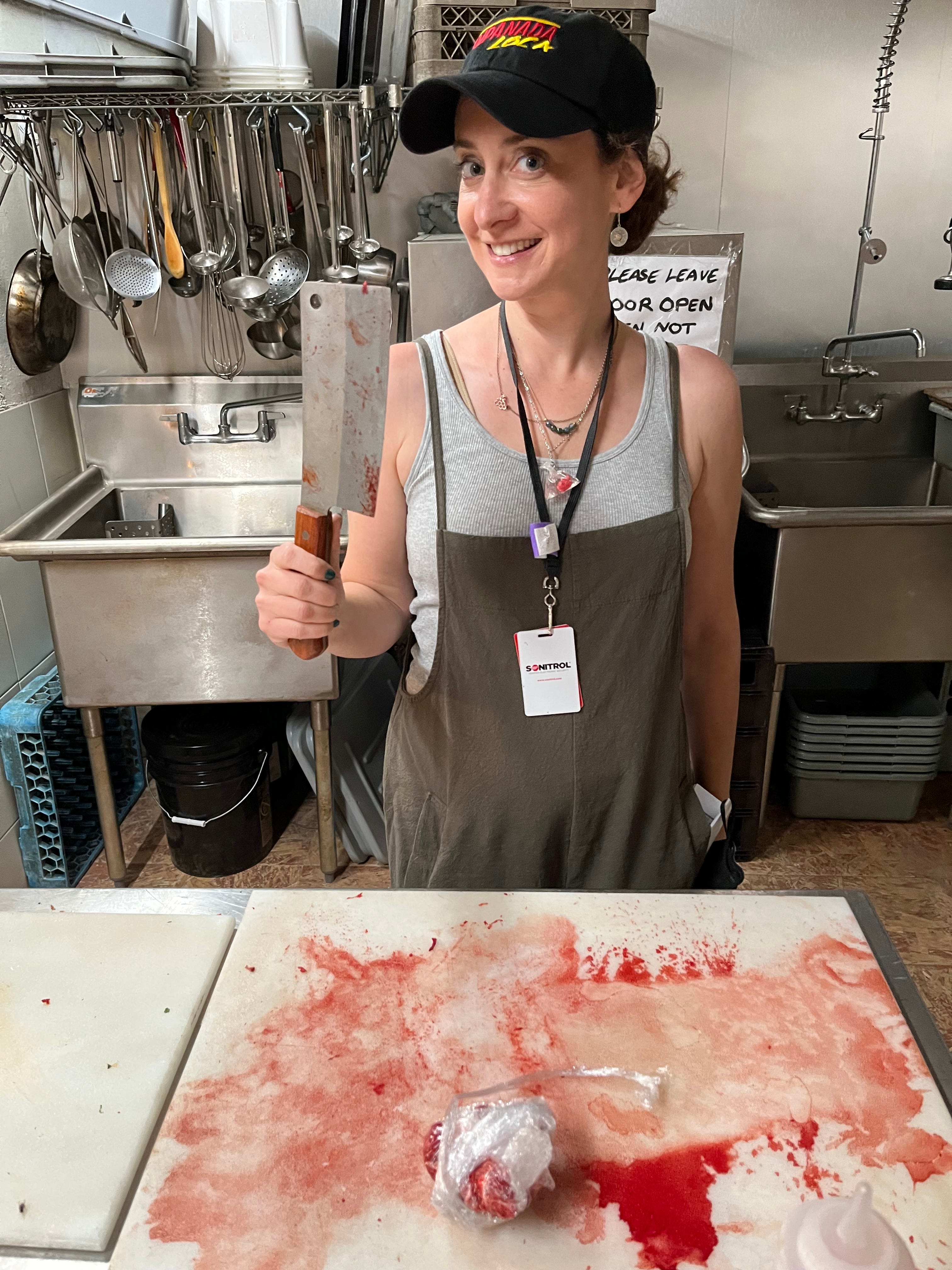
The first time I experienced something creepy at a job was when I interned for the Jim Henson Company in 1997. I was 18, so this was technically legal, but I went to a puppeteer party with friends and was given jello shots, then pressured into getting into my underwear in a hot tub with several grown-ass men. I don’t remember much about it other than nobody tried anything that resembled assault, and at the time, feeling deeply torn between “that was fun” and “that was gross.” I was lucky. When the party was over, the producer I was working with drove me home, didn’t try anything, and we never talked about it again.
Here’s the part that was confusing. I realized I sometimes enjoyed being objectified because objectification equals underestimation. Once you’ve reduced someone to parts, you let your guard down. You aren’t expecting them to be gunning for your job. At every gig between the ages of 18 and 29, I was referred to as “so cute.” Rather than fighting that, I discovered leaning into it disarmed many of the older men I was working with, who didn’t expect me to also be smart, strong, and the hardest worker in the room. Sometimes I could get away with sweetly smiling and saying things that a showrunner like Aaron Sorkin might have bristled at from a male writer. But I was always acutely aware I was playing a role.
This dynamic continued until I wound up on my first show under a gay male showrunner, who didn’t think I was cute, because he had no use for the package my brain came in. He treated me the same as he treated everyone else. He’d been successful really young, and so even though I was 29 and green AF, he trusted me to be on set with little to no supervision, producing huge episodes of an anticipated network show. It was pretty amazing. That was the first time I realized I shouldn’t have to rely on “being cute” to climb the ladder. The reality is, it had never occurred to me that I shouldn’t.
That said, at the time I was writing with my (now-ex) husband. And every room we worked in could have been a sociology experiment in gender bias. It was common for me to pitch an idea that the whole writers’ room would either dismiss or not even hear, and when he would re-pitch the very same idea minutes later, the same people would go, “Now THAT is a great idea!” (He usually gave me credit. That is not why we divorced.) It was equal parts comedy and crazy-making.
Eventually, I grew past the “cute” phase and approached middle age. All those older male showrunners, once charmed by me as an ingenue, no longer had any idea how to categorize me.
The EPK
On my second solo gig, I was the only female writer in the room and one of two on set — the other being the script supervisor, in case you’re wondering. Though I was an upper-level writer at the time who had produced many episodes of TV, I was given a male EP to supervise me on set. He hadn’t read my script, but thank god he was there to make sure my breasts didn’t get in the way of me doing my job. His presence probably contributed to the number of men on the crew who greeted my arrival by handing me trash, assuming I was a PA, asking me whose girlfriend I was, or wondering when I was going back to the art department. My name was on the script and the call sheet.
That show was so male-dominated that there was no bathroom on location some days when we shot in the woods. They assumed crew could pee behind a tree. Scripty and I would coordinate asking for a van to take us back to base, because we knew that without both of us there — especially her — there was no way for them to move onto the next scene that “my” supervisor was most definitely not actually supervising.
One of the producers then asked me to be a talking head on the EPK. When I told them I wasn’t comfortable doing that, he said, “But... we need a woman.” That is, if I didn’t, they’d have zero women on the EPK. I relented.
I know writers of color in white rooms are sometimes asked, “what would a [insert ethnicity] person say here?” I ended up in more than one room where all the men would turn to me and ask, genuinely stumped: “What would a woman do?”
The Set-Up
On one show, the well-meaning married male writers in the room encouraged me to leave for the evening to put my kid to bed (that was kind, but I simultaneously wished I had a wife who took care of all my domestic work for free). When I came in the next morning they told me they’d solved the female character’s story problem — her boss surprised her with a setup, and she was upset about what she was wearing!
I sighed. Yup. Ya fixed it. To the showrunner’s credit, I argued, he relented, assigned me the scene, and I was satisfied with how we pivoted.
I watched that same room nearly get torn apart by #MeToo, as men with daughters realized the kind of world their young women would be working in — and the other men, well, let’s just say they thought the whole thing was a bit overblown. On that show, I received unwelcome massages on set from male directors, crew, and even an assistant. I thought, when it’s finally my time to be the boss, I won’t let this happen anymore.
Except here’s the problem: it did.
The Toe-Warmers
One time as a showrunner, I was changing out my toe warmers on a cold day on location when a crew member grabbed my foot and started massaging it. When I tell you, it was so out of nowhere, I just started repeating: “No thank you, no thank you, no thank you!” Finally, I had to physically remove him from my body. He looked at me, shocked. “My daughter is a ballerina, so I know what I’m doing.” Sorry, sir, whut?!
I had a choice to make. I knew that if I filed a complaint and made it a problem, he might get fired, and either way, the entire set would turn against the Overly Sensitive Showrunner with Lady Hormones and probably say I should be grateful someone was touching me after the age of 40 or victim-blame me for... being flirtatious? Smiling at him too much? Lord knows.
Cut to later on that same show when a male assistant told HR he “felt unsafe” because after my twentieth disconnected conference call I directly asked everyone in the bullpen whose responsibility it was to fix the office phone lines. I’d been begging the line producer to get someone to fix them all season. I told HR I never called names, cursed, or raised my voice. HR admitted it was a bogus, gendered report and asked me to just... please not-do that again. I laugh-cried: “That’s fine. Can someone please tell me how to get the phone lines fixed?” Dear reader, they could not.
On another show, the DP asked me, “Why aren’t they listening to you?” When that DP later became my boyfriend, I gave him the real answer: “It’s the tits. They can’t hear past the tits.”
What “Unlikeable” Really Means
I’ve been touched, handled, threatened, and experienced “mild” physical violence that probably fits the definition of assault at almost every job. And I’ve been disrespected by men who were working for me at all of them in ways that even the nicest male showrunners would never have tolerated. Yet beyond a dark laugh with a colleague, I never registered a complaint. Not officially. Because what would happen if I did?
I still have to prove myself in every room I walk — or Zoom — into. Because whether I make myself smaller so I’m palatable, or I take up more space than a woman “should,” I don’t fit your definition of what a boss looks like.
It’s a cliché when female characters get the note that they’re unlikeable. Here’s the thing about that note: it’s usually not wrong. Because what they mean is she’s not behaving the way I’ve come to expect a woman to behave to keep me comfortable. I get it, because I’ve spent 29 years in this business calculating how loud to be. And it was still often too loud. I never raised my voice about the phone lines. I got reported anyway. Meanwhile, a man massaged my foot without consent and told me it was fine because his daughter was a ballerina. There were witnesses and nobody wrote him up.
So when I write a woman who is too much — too angry, too loud, too honest about what she wants — I’m writing the version of me who didn’t do that math. Who didn’t smile and say “this is fine.” Portraying that on TV might give more women permission to hit back in real life. The proverbial They wouldn’t want that.
Sometimes the “unlikeable” note is delivered when all the feminists in a writers’ room have told on themselves with a story. They use the character to say: we shouldn’t have to tolerate one more ounce of this.
I used to take the note as a taste issue. Now it’s data. It says something about the person giving it. Unlikeable in a man reads as complicated — House, Don Draper. Give that note about a female character and it means: this woman scares me.
After all this, I wouldn’t change a thing. Being a woman in Hollywood means I knew I was going to have to be better, work harder, sound smarter, and think outside the box in every possible way. Every successful woman I know in this business is the immortal phoenix, rising from the ashes of indignation on every set, every room, every notes call. But the Phoenix has her own weapons. When she rises, she flaps her wings; the sparks singe anyone who gets too close.
It’s very true. I’m surprised it hasn’t gotten much better. Though I remember even female executives (probably mimicking their male bosses) doing this with male underlings. Not on the level women get it or even close but it’s weird how power can change how people act. You think oh Hollywood is so liberal that this stuff isn’t relevant anymore and that’s probably a bigger problem in other conservative industries but it’s not. I mean I’m sure those have it too but Hollywood is up there. I remember every office I went to for prodcos or agencies would always have attractive females up front in the assistant role and much less attractive men in the back in executive roles. Typical though you go back ten years later and whoever was in the front graduates to the back, but I still go to the offices and it’s different attractive people up front and the same ugly guys in the back!
So exactly right. Used to be that way in the newsroom at the large newspaper I worked for. Then, after I left, it wasn't. Then there were no more newspapers.